Home
 Spectio
Launch, watch and steer Nextflow and Snakemake runs.
Stop at QC gates, decide from your phone.
Hand the results to depictio.
An open-source run manager for bioinformatics pipelines on HPC and Kubernetes, with a headless API and a plugin for everything. Spectio is in its design phase: everything below is specified and reviewed in the open before code is written.
Pipelines on clusters are still launched by hand, followed in log files, and checked after the fact. A failed sample is noticed when the report is read; a run that should have stopped after QC burns a week of CPU. Spectio watches the run from the engine's own events, stops it at the stages you choose, shows the evidence to whoever must decide, and resumes from the cache.
Works with
Nextflow
trace, weblog and -resume, 25.10 and 26.10
Snakemake
logger and executor plugins, --until, 9.x
nf-core
14 pipelines in the test corpus, with their test data
Snakemake Workflow Catalog
9 workflows, run on their .test data
depictio
same identity, groups and branding; results handed over
CWL · WDL
later, through engine plugins
What it is made of
Runs
One place for every run, with tasks, samples, logs and costs.
QC gates
Stop after a stage, review the evidence, exclude samples, resume.
Runners
SLURM and other HPC schedulers, Kubernetes with Kueue, a laptop.
Headless API
Everything the UI does, scripted; events, webhooks, RO-Crate.
CLIspectio run, watch, gate, with models shared with depictio.
Plugins
Engines, launchers, auth, notifiers, storage: entry points, like Snakemake.
Administration
Users and groups, branding, tasks, logs, backups and migrations.
Share links
Magic links, scoped reviewer links, OIDC and SAML, provisioning.
depictio hand-off
Finished runs become dashboards, with the same users and groups.
Key ideas
01
Gates stop the right stage. A gate uses the engine's own stop, a generated Nextflow config or a Snakemake --until, then resumes from the cache. Measured on the synthetic test pipeline: 25 of 65 tasks come back cached after the QC gate, on both engines.
02
Decide anywhere (planned). A reviewer will open a scoped link on a phone, see the QC evidence, exclude a sample and approve, with no account needed and every use audited (share links).
03
Runs where the data is (planned). A small runner on the login node or in the cluster will pull commands over HTTPS, so the HPC side needs no inbound port (runners).
04
One Python package to start (planned, not published yet). One package will give the CLI and the runner, with an extra for the server on SQLite; Docker Compose and a Helm chart come next (packaging).
05
Tested on real pipelines. Twin synthetic pipelines already pass 11 failure and gate scenarios on two Nextflow versions and Snakemake, and nf-core/demo passes with its test data. The plan: every pull request runs them, then the nf-core and catalog corpus, once CI is green (step T7).
How a gate works
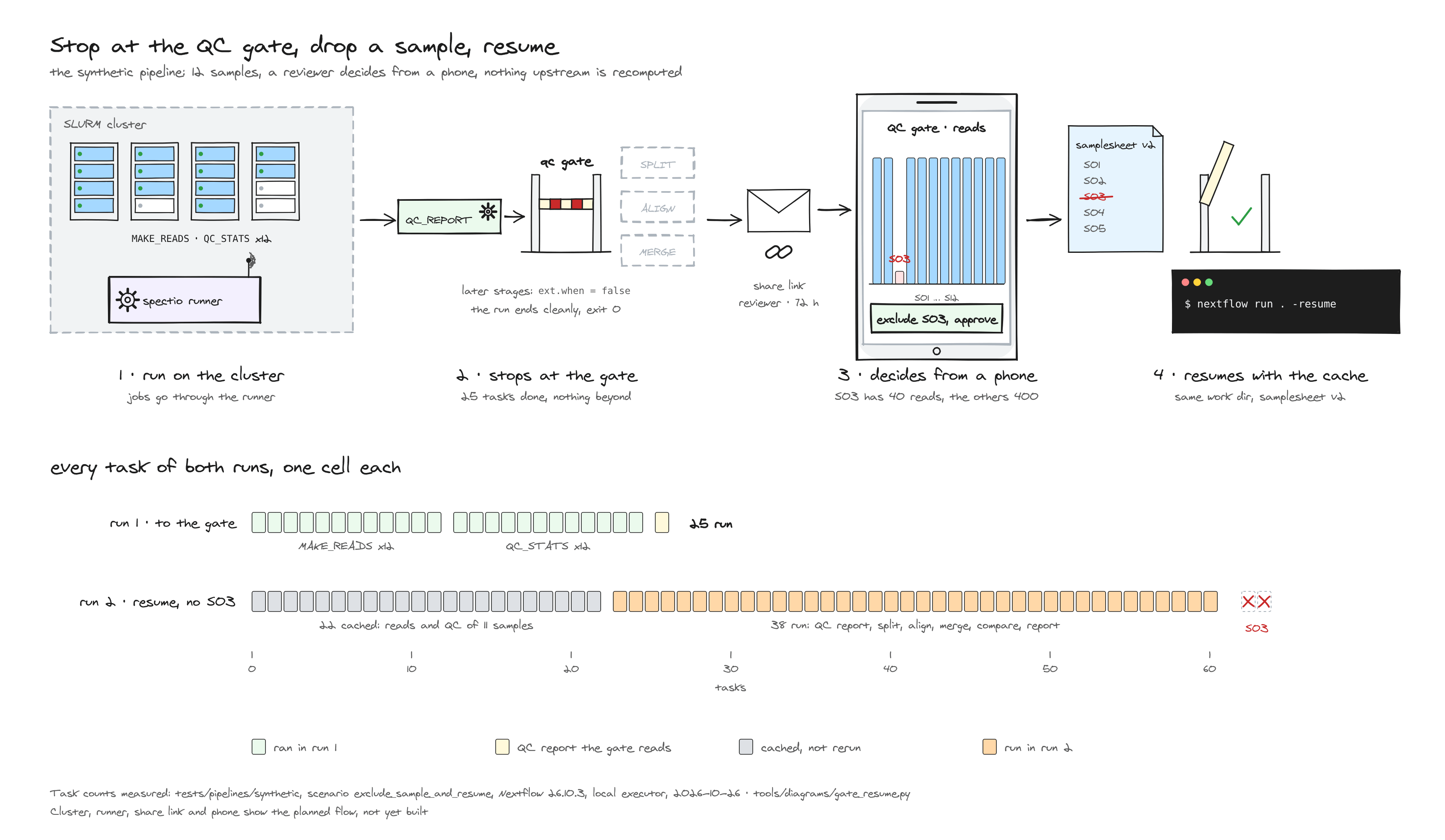
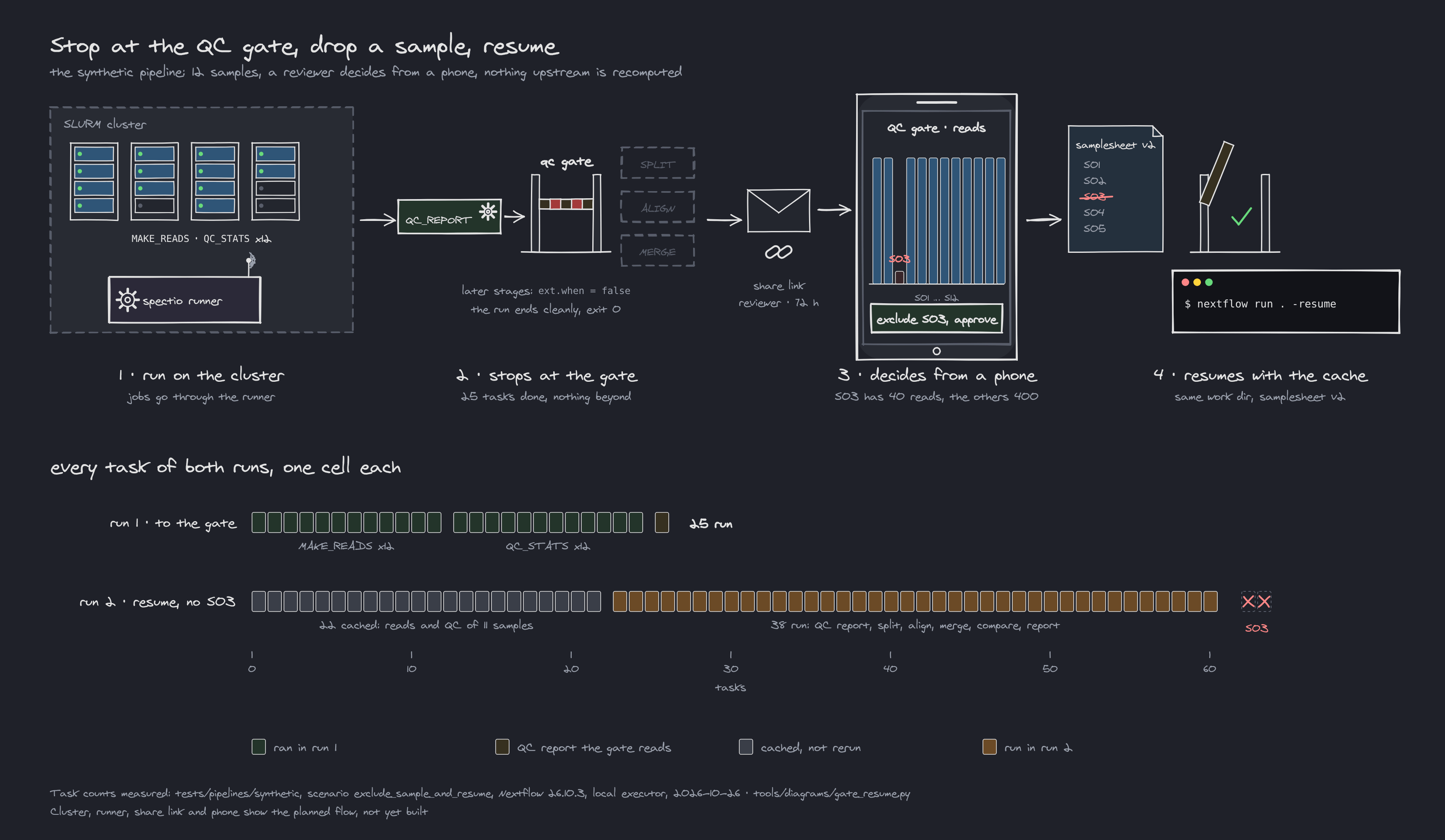
Task counts measured on the synthetic pipeline; the cluster, runner, share link and phone show the planned flow. Click for the full size.
Where the design stands
W07/7Foundations, done interactively with Thomas (2026-10-24 to 26)W10/9Independent reviews and the first spike (read-only, parallel)W20/6Triage and apply W1 findings, then the reviews that need cleaned specsW30/14Development layer and test infrastructure (parallel worktrees)W40/3Synthesis, plan and the one human decisionW50/2Implementation of the walking skeleton
Start reading
- Synthesis: what Spectio is, the engines, the existing tools and the stack.
- UI spec: every screen, phone included.
- Checking scenarios: what a gate checks, across nf-core.
- Documentation map: every spec and which topic it owns.